RainFormer
Subseasonal Rainfall Prediction from Sea-Surface Salinity
Overview
RainFormer is an AI-driven forecasting system designed to predict rainfall at 2–6 week lead times — the subseasonal window that sits between traditional weather models and seasonal climate outlooks, and where reliable forecasts have historically been hardest to produce.
The key insight driving this work is that sea-surface salinity (SSS) acts as a long-term climate memory signal. Salinity evolves slowly and encodes persistent ocean–atmosphere interactions that influence future moisture transport and precipitation. By leaning on this stable oceanic signal, RainFormer extends predictability into a time horizon where conventional atmospheric models lose skill.
The Science
Sea-surface salinity is set by the balance of evaporation, precipitation, and ocean circulation. Areas that evaporate more than they receive rain become saltier; areas receiving heavy rainfall freshen. This means the salinity field carries a running record of where and when precipitation has occurred — and through ocean dynamics, it encodes information about conditions that will influence future rainfall weeks out.
Unlike sea-surface temperature, which responds quickly to atmospheric forcing and loses its predictive signal in days, salinity anomalies persist long enough to be useful at subseasonal lead times — making it a particularly valuable input for the 2–6 week forecasting problem.

Approach
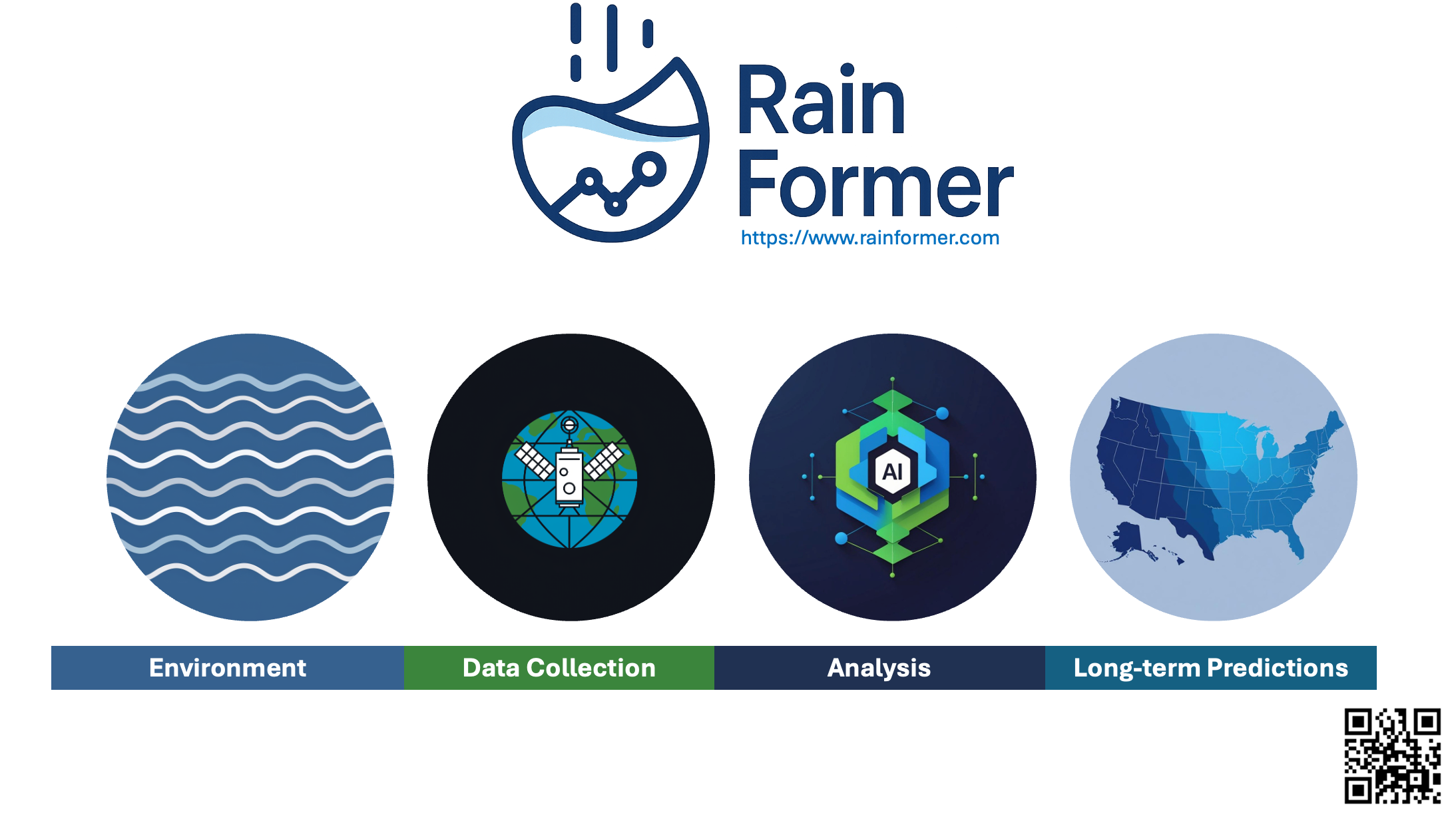
RainFormer synthesizes diverse oceanic and atmospheric observations using a proprietary combination of AI methods trained to detect the slow-evolving precursors of subseasonal rainfall anomalies. Rather than fixing a single variable or model structure, the system integrates multiple climate indicators, allowing it to capture the complex, nonlinear relationships between ocean state and future precipitation.
The system is built on publicly available environmental datasets and is designed to be scalable and regionally adaptable — not tied to a specific geography or application domain.
Applications
- Water & Infrastructure: reservoir operations, flood and drought preparedness.
- Agriculture & Food Systems: improved crop management and irrigation scheduling.
- Emergency Management: earlier alerts for extreme precipitation events.
- Energy & Utilities: hydropower planning and grid load forecasting.
- Finance & Insurance: climate risk intelligence for exposure management.
Impact
RainFormer addresses a historically uncertain forecasting horizon with direct operational and economic consequences. Improved subseasonal predictions reduce reactive decision-making across water, agriculture, energy, and emergency sectors.
The current system operates at a 30-day lead time with a 14-day prediction window. The central research goal is to push well beyond this envelope — toward season-to-season prediction, where forecasts issued for one season carry skill into the next. Salinity's slow-evolving nature makes it a physically motivated candidate for bridging that gap; the open question is how far the predictive signal actually extends and what additional ocean–atmosphere variables are needed to sustain it.
A parallel direction examines the role of historical training depth as a lens on climate change. By systematically varying how far back in time training data reaches — from decades to a century or more — and evaluating the resulting models on future periods, we can study how shifting climate baselines affect predictive skill. If models trained on older data perform differently from those trained on recent observations, that divergence itself becomes a signal of long-term climate drift, offering a data-driven way to characterize how much the ocean–precipitation relationship has changed over time.