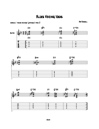
Nothing too fancy in this lesson -
these are a couple of choruses of
blues changes. Each chorus uses a different outlook in selecting
voicings. (The two choruses are not
meant to be played one after the
other; the last chord in chorus 1 definitely doesn't voice-lead well
into the first chord of chorus 2!) My purpose here is simply to
illustrate two different ways of thinking about voicings. This lesson
is about harmony, not rhythm: I just wrote out the chords in whole and
half notes. You can use them rhythmically in any way your heart desires.
In chorus 1, I'm using the "inside
voicings" approach mentioned
elsewhere on this site. In other words, I'm
keeping all the chords
between the E strings. I'm also trying to keep the voice-leading
smooth: most of the time, individual voices are moving by whole or half
steps. Note that roots are not always included in every voicing. The
root is the most obvious note in a chord; we don't always need to play
it, especially in a group context with a bass player. Leaving out roots
(and sometimes fifths) frees up fingers and strings for less obvious
chord tones. I strongly recommend that you analyze these voicings;
figure out which chord tones are included and how they move to tones in
the next chord.
The Db9 in the last bar is a "tritone sub": normally, you might expect
a G7 there (or a Gm7). G7 and Db7 share the same "guide tones" (3rd and
7th). The 3rd of G7 is the 7th of Db7; the 7th of G7 is the 3rd of Db7.
That's why tritone subbing works. If you left the root out of that Db9,
a bass player could play G under it and it'd be heard as a G+7. Either
way, it does the same job - it pulls you to C7.
In chorus 2, I wanted to play around with the idea of having whole
steps in most of the voicings. I like the sound of fourths and seconds
combined, and that sound gets used a lot here.
One of the things you'll read in most guides to "jazz harmony" is that
you need the "guide tones" (3rd and 7th) in every chord. That's
usually not a bad idea, but Herbie Hancock proved way back in the '60s
that it's not always necessary. Especially in the context of a jazz
group,
somebody's probably
going to play whatever chord tones you might leave out, even if just
for a split-second! The group sound (assuming everybody can play!) will
reflect the harmony of the moment pretty well; you don't have to worry
so much about encompassing the whole harmony by yourself. For example,
the voicing in the first bar of chorus 2 is labeled "F13". It actually
has no 7th in it at all and could just as well serve as an F6/9
voicing. In the context of the blues, however, it's probably going to
be heard as part of F13 in the overall group sound. In many of the
other voicings, I often choose to leave out a 3rd or a
7th so I can maintain the intervallic structures I'm looking for. If
you haven't experimented much with this idea, some of the chords in
chorus 2 may sound peculiar to you, especially when you're playing
alone. But try them out in a group setting and I think you'll find them
pleasing. As with the first chorus, analyze the chords to see which
tones are present and how they move. Most of the chords have a fourth
on top and a major second in the middle. The rootless Gm9 in the ninth
bar is the only chord that's comprised of thirds.
Again, nothing too earth-shaking here, but you may discover a few ideas
you haven't tried before. I hope you enjoy playing these! Peace out.