
Fig. 4. A pretty cluttered room by anyone’s measure, from Shadwwulf. Hoarding Living Room. 1 Oct. 2001, https://commons.wikimedia.org/wiki/File:Hoarding_living_room.jpg, CC BY 3.0, Wikimedia Commons.
This text discusses the relationship of waste to memory, understood as a rhetorical practice shared among networked human and non-human agents. But first, because all possible topics have been addressed in The Simpsons, we might begin with the requisite clip. It comes from the 2009 episode “Bart Gets a ‘Z,’” and in it, Bart’s dowdy fourth-grade teacher Ms. Krabappel confiscates her students’ smartphones because she believes that they are a distracting educational impediment (see fig. 1):
Fig. 1. Ms. Krabappel confiscates her students’ smartphones and lands in a pedagogical pickle, from Mark Kirkland, “Bart Gets a ‘Z,’” The Simpsons, season 21, episode 2, Fox, 4 Oct. 2009.
Notice that when class bully Nelson Muntz calls Ms. Krabappel’s bluff and goads her to “teach us, using only the knowledge in your own head,” she becomes flustered, quickly turning to the obsolete 8-bit classroom computer and booting up a primitive word completion game. An arch Nelson quips that his “stroked-out grandfather has more memory than that thing.”
Shortly after this incident, Ms. Krabappel is replaced by Zachary Vaughn: her young, hip antithesis, with an M.Ed. from Tufts and abundant tech savvy. Mr. Vaughn immediately returns the students’ smartphones and texts them their first homework assignment: 20 minutes of twittering. Later, Mr. Vaughn asks the students what the Monroe Doctrine was, seemingly inviting a regurgitated response (see fig. 2):
Fig. 2. Martin Prince attempts to polish apples but faces an existential crisis instead, from from Mark Kirkland, “Bart Gets a ‘Z,’” The Simpsons, season 21, episode 2, Fox, 4 Oct. 2009.
In this clip, class know-it-all Martin Prince eagerly raises his hand and begins to articulate a precise summary of the policy before being interrupted by Mr. Vaughn’s peevish question: “Are you telling me you memorized that fact when anyone with a cell phone can find it out in 30 seconds?” A visibly dejected Martin stammers: “I…I…I’ve crammed my head full of garbage!”
Memory and knowing are contested within Bart’s classroom. Both Nelson’s challenge to Ms. Krabappel and Martin’s lamentation about his wasted head space reveal a paradigm that validates knowledge only when it is confined within the brain’s biological perimeter and does not rely upon an external prosthesis at a discrete moment of prompted recall. Or, if we are to understand Nelson and Martin more theoretically than anatomically, they endorse a Cartesian “I” that knows and is thereby meaningfully differentiated from an externalized object of knowledge. Mr. Vaughn’s contrasting stance is that knowledge emerges from a distributed, shared social repository that is readily available through material networks, which casts knowing as the ability to locate information on demand rather than compile an internal data stockroom. Nelson’s coarse pun about his grandfather’s memory loss after a stroke provides further nuance, as it unites the seemingly distinct concepts of biological and digital memory. Ms. Krabappel also contributes to this dialog. Her reflexive reliance on the classroom computer starkly contradicts her condemnation of the students’ continual use of smartphones. We see in Ms. K. a familiar ambivalence: acceptance of digital technology when it is a circumscribed tool coupled with discomfort when it is an amorphous, ubiquitous ambience. Material objects are benign as external props but threatening as an integral aspect of cognition. Lingering over all is the whiff of Martin’s mental garbage—the fear that the mind is a finite storehouse that one must vigilantly curate, lest it become cluttered with kipple.
These vignettes are rich, but I don’t present them because they are uniquely insightful; they are productive precisely because they are disposable. Epistemological questions about cognition in an era of digital networks that store, order, and rapidly retrieve vast amounts of information are pervasive enough that glib moments from a popular television show are dense with relevant rhetorical concerns regarding what it means to know, who (and what) is capable of knowing, and how to value the objects of knowledge. The Simpsons demonstrates that memory’s status is crucial to these issues, and memoria’s material aspects have been fraught since antiquity, as is evident in Plato’s well-known screed against writing in the Phaedrus. Jacques Derrida comments in “Plato’s Pharmacy” that through the fable of Thamus and Theuth, Plato attacks writing as “the substitution of the mnemonic device for live memory, of the prosthesis for the organ; the perversion that consists of replacing a limb by a thing” (108). Derrida contends that Plato’s endorsement of internality was an intentional reaction against traditional models that privileged divine inspiration and contemporary sophistic frameworks that entangled the rhetor with circumstances: as the Homeric speaker channeled the Muses’ whispers, the sophist was a kairotic, situated stitch point amongst memory objects. In Applied Grammatology, Gregory Ulmer expands Derrida’s critique by asserting that Plato’s conception broke with a deep classical lineage of mnemotechnics that didn’t sharply distinguish internal and external, real and artificial:
Plato is condemning writing not just as “writing-down” but as a whole theory of the relation of memory to thought. Plato’s diatribe against the sophist condemns artificial memory (hypomnesia) in general, including mnemotechnics, the system of topoi, or commonplaces (“the tupoi are the representatives, the physical surrogates of the psychic that is absent?”) developed for rhetorical training. (69, italics in original)
Mnemonics such as the method of loci attributed to the ancient Greek poet Simonides and refined by Roman rhetoricians including Cicero and Quintilian function by placing humans and objects in broad cognitive networks and associating ideas with aspects of speakers’ physical surroundings. Materialized thought also underpins the topoi of Plato’s student Aristotle, as Ulmer reminds us. George Kennedy perhaps goes further, averring that Aristotle’s overarching intellectual project may be understood as a spatialized taxonomy of subjects or a “map of learning” (76).
As Ullmer suggests, it’s not writing down that Plato rejects: it’s the transformation of thought itself into an object—an impoverished effigy of active human cognition. For Plato this was anathema, but such externalizations potentially have made the system that encompasses humans and non-humans more functional and intelligent. Technologist Kevin Kelly adopts this position in What Technology Wants; he depicts writing as an evolutionary extension of species-level data transfer and claims that the information exchanged through genes has been supplemented by social memory transmitted via language (342–43). In his book Natural-Born Cyborgs, cognitive scientist Andy Clark sees a materialist intellectual shift in the emerging literacy of classical Greece, asserting that “when we freeze a thought or idea in words, we create a new object upon which to direct our critical attention. Instead of just having thoughts about the world, we can then make those very thoughts (and thought processes) the targets of more thinking” (79).
The connection of knowledge to objects in space is neither just a convenient metaphor nor a vestige of antiquity. John O’Keefe and Lynn Nadel’s seminal 1978 neuroscience study The Hippocampus as a Cognitive Map asserts that the human brain constructs “a neural memory system providing an objective spatial framework within which the items and events of an organism’s experience are located and interrelated” (1). Subsequent research in this area explicitly identifies Simonides’s method of loci as an early recognition of the link between memory and space (Nadel 217–18). In the social sciences, Mihaly Csikszentmihalyi and Eugene Rochberg-Halton’s The Meaning of Things surveys people about how they draw meaning from the constellations of objects in their domestic environments—things that clearly are more than the mere memory prompts that Plato disparages. In the book, a 62-year-old grandmother using “well-chosen words” states that the items in her home “represent my hard-earned final composite identity” (qtd. in 143). Another subject states of her treasured possessions: “If I didn’t have them, I probably wouldn’t be the same person. They sort of mold my personality” (qtd. in 190). An additional interviewee contends that “everybody’s made up of different things. They’re part of me in the respect that they make up my personality” (qtd. in 190). The youngest member of the interview pool states that “all my special things make me feel like I’m part of the world” (qtd. in 193).
We can see similar sentiments elsewhere. We might take two minutes and watch the trailer for the 2021 documentary Objects (see fig. 3):
Fig. 3. The trailer for the documentary Objects, from Vincent Liota. Objects (Trailer). Semicolon Pictures, 2021.
The filmmaker’s description of the work asserts that it is “about holding on to our place in the world; our identity, self, and sense of belonging. About the people who we love and have loved. Objects represent the past, reminders of the moments that make us who we are in the present” (Liota).
Each of us could readily identify ways our own self narrative is articulated by physical objects in space. Memory and knowing occur through interactions that stretch beyond our brains. We do not and cannot, for example, know the time except as an object of thought constructed by the clock. Plato’s trepidation about prosthetic memory technologies was tied precisely to the hybrid modes of cognition they enabled and how they produced a human form that was, for him, adulterated. But if we zoom out a bit and take in the broader sweep of a system entangling human and non-human constituents, we can see a plexus that is productive in otherwise impossible ways. Outcomes including Plato’s own written dialogues and Aristotle’s taxonomy—his map of learning—require an external format to function. Human plus object is smarter and better than human alone, but only if we see these entities as mingled elements.
Nevertheless, the augmentations delivered by our objectified memory come with costs. Csikszentmihalyi and Rochberg-Halton’s work hints at the risk of our extended minds: the possibility that pieces of oneself could be lost, destroyed, or stripped of utility. Journalist Adam Minter’s book Secondhand documents the trauma people experience when compelled to shed personal possessions due to a change in life circumstances. Grown children do not want and cannot accommodate sectional sofas, oak dressers, obsolete vacuum cleaners, and grandma’s bed sheets. But before their owners can part with the items, they need assurance that they will have some future value—some form of ongoing existence. “There’s a grieving process,” reports Jill Freeman, a marketing associate with Gentle Transitions, a moving consultant specializing in downsizing senior citizens (qtd. in Minter 9). Minter underscores the links between objects, memory, and selfhood, observing: “As possessions are set aside, a more profound grieving takes place. It’s not just the loss of a sentiment; it’s the loss of an identity” (9). Crucially, such transitional objects associated with grief are not a product of contemporary affluence; they have been part of human existence for millenia, as demonstrated by Richard Goldstein et al.’s “Transitional Objects of Grief” and Lindsey Büster’s “‘Problematic Stuff’: Death, Memory and the Interpretation of Cached Objects.”
But let’s push even further than Goodwill purges and assisted living. What are we to make of the images in fig. 4, fig. 5, and fig. 6?
Fig. 4. A pretty cluttered room by anyone’s measure, from Shadwwulf. Hoarding Living Room. 1 Oct. 2001, https://commons.wikimedia.org/wiki/File:Hoarding_living_room.jpg, CC BY 3.0, Wikimedia Commons.
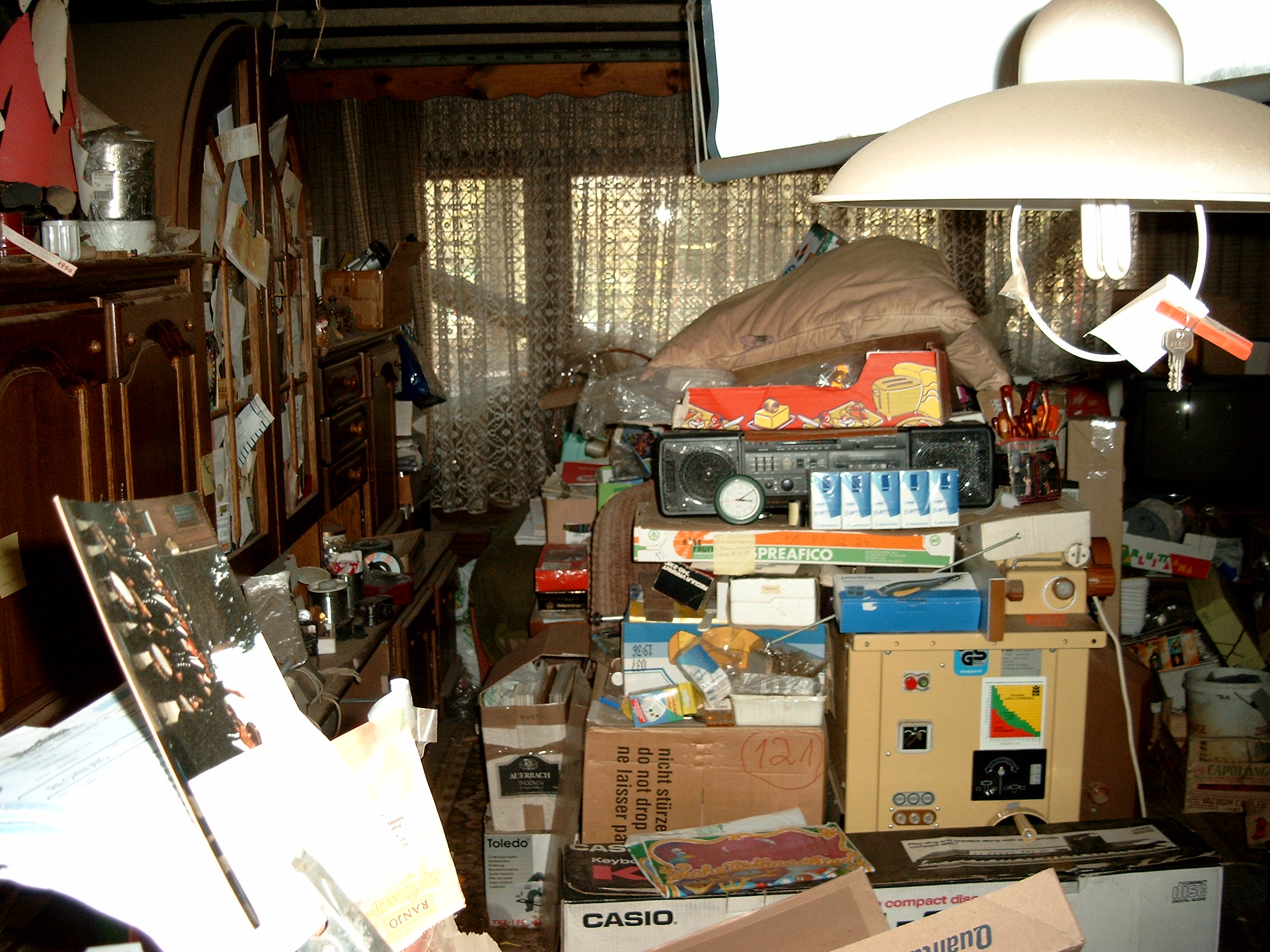
Fig. 5. Oof, here’s another one, from Grap. Compulsive Hoarding Apartment. 10 May 2009, https://commons.wikimedia.org/wiki/File:Compulsive_hoarding_Apartment.jpg, CC BY-SA 3.0, Wikimedia Commons.

Fig. 6. Oh boy, the kitchen too? This is giving me the sweats, from Un Touriste. Syllogomanie-Puteaux. 3 Aug. 2011, https://commons.wikimedia.org/wiki/File:Syllogomanie-Puteaux.jpg, CC BY-SA 3.0, Wikimedia Commons.
What is our response to Biggie Clean’s TikTok channel, which contains videos of Biggie himself cleaning severely soiled and cluttered spaces (see fig. 7)?
Fig. 7. TikToker Biggie Clean tidies a rubbish-filled house, from Biggie Clean. “Hoard Muck Out.” TikTok, https://www.tiktok.com/@biggieclean?lang=en. Accessed 15 Dec. 2021.
His channel has 4.1 million followers and 49.4 million likes as of December, 2021. Fascination with clutter and cleaning, with the catharsis of the purge, resonates with multitudes.
What we see here of course is hoarding, the most striking manifestation of memory’s material aspects and a defined psychological disorder in the DSM-5 (American Psychiatric Association 247–51). Hoarding vividly exposes the potency and peril of our physical entanglements precisely because it is debilitating. Despite the recent spate of popular media about the subject, including the television shows Hoarders and Hoarding: Buried Alive, hoarding is not a modern phenomenon; it appears in Dante’s Divine Comedy, Jonathan Swift’s Gulliver’s Travels, and several of Charles Dickens’s works. However, because it requires possessing excessive tangible objects, it is tempting to view it as a form of materialism run amuck. Yet hoarding is yoked to memory, as Stuff: Compulsive Hoarding and the Meaning of Things, by hoarding experts Randy Frost and Gail Steketee, asserts. This book clarifies that rather than organizing their worlds through conceptual categories, hoarders arrange cognition spatially by offloading memory onto objects (30). For instance, Irene, one of the book’s subjects, knows that her electric bill is on the left side of a paper pile about a foot down. She trusts this form of mnemonic wayfinding more than she trusts herself to remember to make the payment. Frost and Steketee state, in words so haunting that they make me perspire, “Many of us do this. I have faculty colleagues whose offices are populated by piles of paper, and although they get a bit nervous that I’ll label them hoarders, most actually know what each pile contains and can readily find what they need” (30–31). As I read these lines while sitting in my home office, I slowly turned my head to the left and saw this (see fig. 8):
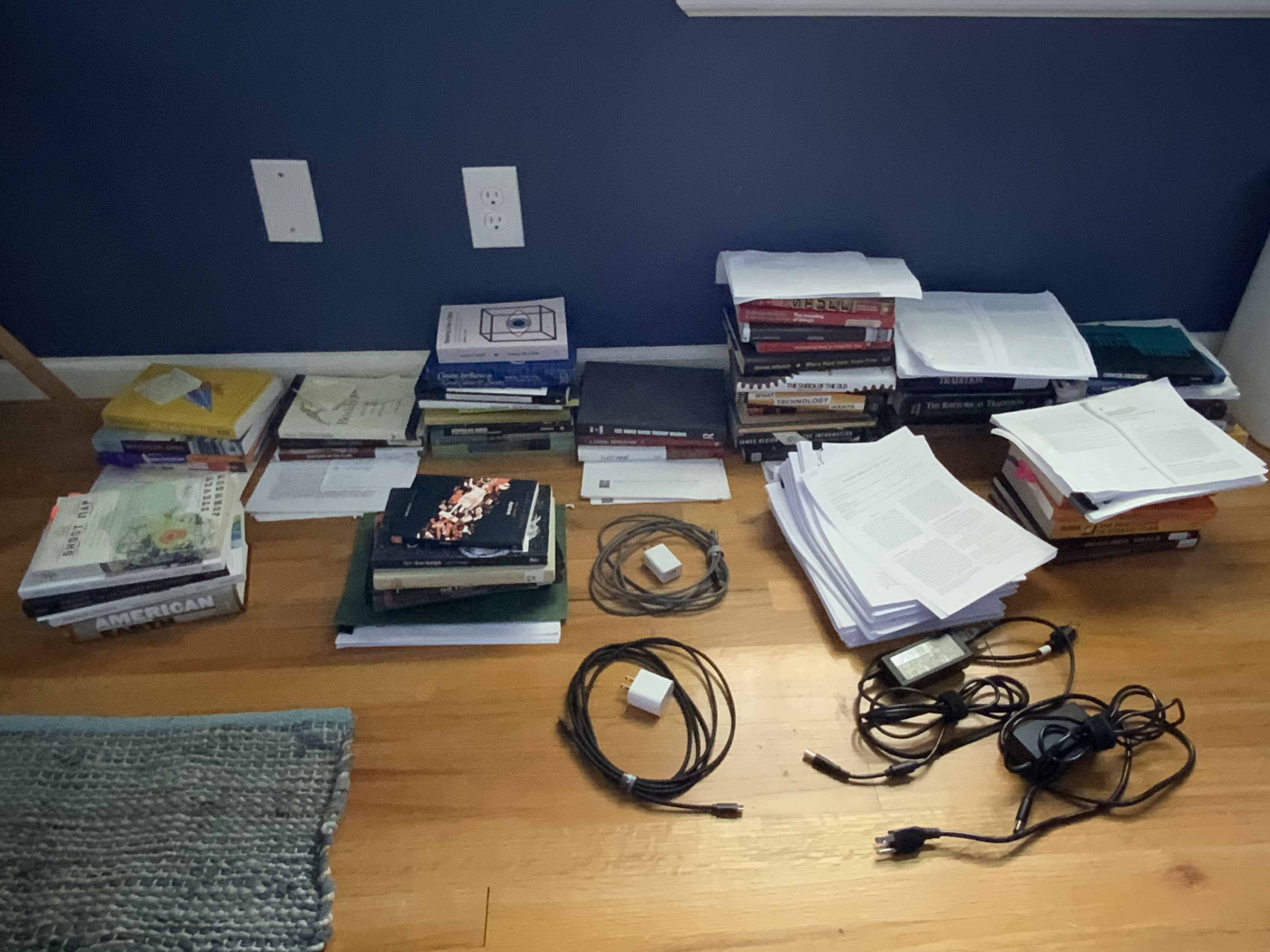
Fig. 8. This photo taken by the author does not show a symptom of anything; it captures a totally normal home office that in no way suggests that academic practice operationalizes behavioral disorders.
If hoarding is a plague of matter and memory, seemingly it could be treated with a digital information architecture. We could slip files into the euphemistic cloud rather than stack papers into piles and cram storage units with detritus. Of course, this is already occurring; we might pause here for a moment to tabulate our emails, our files, our open tabs, our bookmarks, our Instapaper and Pocket lists, and our seemingly infinite queues for Netflix, Disney+, Hulu—all the bottomless reminders of unmet cultural expectations and manifold promises that something will be comprehended within an indefinite future. It’s not surprising that contemporary behavioral research has identified a condition called digital hoarding, which is excessively retaining electronic information (van Bennekom et al.; Luxon et al.; Neave et al.; Sweeten et al.). Jill Freeman of Gentle Transitions was manifestly correct when she stated that “hoarding is a spectrum disorder. It’s just a question of where you land on that spectrum. And we all do” (qtd. in Minter 9).
Plato might sneer upon hoarding in triumph and declare that it is the end result of relying on a prosthesis instead of a limb. Here are they who seem to know much but really know nothing. But it is not as simple as Plato would have it; our hoarders are ourselves. We might return to Martin Prince’s lamentation that he has filled his head with garbage and acknowledge that we are entangled in pervasive digital networks that retain and recall exponentially more information than could any human—or seemingly even all humans. What then is our role, and what are we to make of the stuff in our heads? Some of the most seismic changes in Human-Computer Interface (HCI) in the past two decades are related to search: the ability to manage the vast amount of data we access. Google of course has emerged as the de facto means to filter the influx of information from the web, and it has been joined by natural-language assistant services such as Apple’s Siri and Amazon’s Alexa. As Mr. Vaughn asserts, memory has become not what is held but what is findable.
Evidence of this shift abounds. Monica Chin’s 2021 article “File Not Found” for the technology website The Verge caused some mild perturbation in academia, as it reported that higher education students increasingly are so accustomed to working within constantly networked cloud paradigms that they do not understand seemingly fundamental computer concepts such as files, taxonomies, and local storage. Their stuff is just out there in an unbound space. The idea that documents are discrete things kept within a strict hierarchy of nested directories on a physical object is becoming incomprehensible. A schism is widening in HCI between taxonomy and search, between information inhabiting a fixed place and being amorphously ready on demand—or even before then, by anticipating our needs.
Such developments underscore that the practice of memory is contextual and situated. Internal Platonic memory is valuable in a milieu of information scarcity and constrained network connections. Secondhand makes the analogy to hoarding by pointing out that prior to World War II, the USA was primarily an agrarian society, like most of the world. In this situation, property was scant, precious, and generational (Minter 16). The frugal clinging to material goods prompted by the Great Depression was a heightened form of what had been conventional practice for much of human existence. Similarly, it is prudent to hold data internally, however the body’s perimeter is drawn, when it is rare because this is the best means to store, transport, and share it. Writing changed this scenario, but it is not feasible to carry all necessary textual material perpetually.1 The material means of information retention and circulation now have shifted such that it is no longer preferable for humans or print works to function as the principal archives in our broader cognitive system, as James Gleick discusses in his book on information theory The Information: A History, a Theory, a Flood. It is now possible for all multimedia data that has ever existed and more to be remotely accessible, so our biological capacities for memory and recall have been superseded by environmental elements. Moreover, as digital media’s information capacity has increased, its relative physical size has reduced. A thumbnail-sized microSD card holds exponentially more data than a paperback-sized hard disk from 10 years ago (which, of course, held exponentially more data than an actual paperback).
This is why the relationship among humans, digital technology, memory, and knowing is relevant now; as mentioned in the beginning of this work, the rise of digital technology has implicated humankind in an ongoing cognitive shift akin to the one protested by Plato. One need only look at recent notable texts to see expressions of similar Platonic hand-wringing, such as Nicholas Carr’s book The Shallows: What the Internet Is Doing to Our Brains (ironically revised for Amazon’s Kindle e-reader), which is an extension of his earlier piece in The Atlantic, “Is Google Making Us Stupid?”. Adrian Ward’s 2021 study “People Mistake the Internet’s Knowledge for Their Own” in PNAS uses starkly Platonic terms to caution that the internet has become—shudder—a “neural prosthetic” that is unlike a library due to its “incessant and instantly accessible streams of data.” Recalling Plato’s criticism of writing, Ward focuses on search engines’ speed and precision as a concern, because how they operate may implicitly cause people to align them more with internal recollection than with the more frictional and laborious process of looking up information in other external formats, such as print. He bases his assertions on a deft series of branching experiments showing that people who are allowed to use search engines to locate information consistently overestimate their ability to do similar tasks without the aid of online networks. John Timmer’s discussion of Ward’s research on the technology website Ars Technica suggests that this reveals a form of the Dunning-Kruger effect, the well-known psychological bias that describes the tendency of people with limited experience in a knowledge domain to overestimate their competence within it. Nevertheless, such pessimistic sentiments are opposed by more utopian notions of digital technology’s impact on human cognition, such as Jamais Cascio’s response to Carr in The Atlantic “Get Smarter.” There are also more modest statements that digital networks are changing human cognition to suit different contexts as old capacities molt into new ones. Such is the overall claim of the Janna Anderson’s Pew Internet & American Life Project’s “Future of the Internet IV” study, which is a large survey of technology experts on these issues.
The notion of digitally enhanced memory is not novel. The principles of a cognitive schema that enfolds humans and digital networks are contained in the concept of transactive memory outlined by Daniel Wegner during the mid-1980s—shortly after the emergence of the personal computer—in works including “Transactive Memory: A Contemporary Analysis of the Group Mind” and, with Toni Giuliano and Paula Hertel, “Cognitive Interdependence in Close Relationships.” The transactive memory model seeks to explain how units including families, teams, and organizations can function as a “group mind,” a memory complex that stores more information than a lone individual and functions in more sophisticated ways (Wegner et al. 253). Individuals need not retain redundant copies of the group’s sum knowledge; each member contributes knowledge and has a functional understanding of how to access other shared information.
Expanding transactive memory to incorporate digital technology significantly changes memory’s status and practice by introducing new kinds of cognitive partners, as limned by Clark and Kelly. Betsy Sparrow, Jenny Liu, and Wegner’s 2011 article in Science “Google Effects on Memory: Cognitive Consequences of Having Information at Our Fingertips” asserts, with some ambivalence, that “the Internet has become a primary form of external or transactive memory, where information is stored collectively outside ourselves” (776). In a contemporary interview, Sparrow rejects Platonic fears of human memory attenuation by framing digital expansion in transactive terms: “We’re not thoughtless empty-headed people who don’t have memories anymore, but we are becoming particularly adept at remembering where to go find things. And that’s kind of amazing” (qtd. in Krieger).
Fittingly, the implications of digitally mediated transactive memory systems have been explored within rhetoric studies. Collin Brooke’s 2000 article “Forgetting to be (Post)Human: Media and Memory in a Kairotic Age” and the “Persistence” chapter of his 2006 book Lingua Fracta: Towards a Rhetoric of New Media theorize a revised memoria that features an assemblage of knowers embedded within online information concierge services that they both use and augment. My chapter “Latourian Memoria” in Paul Lynch’s and Nathaniel Rivers’s 2015 collection Thinking with Bruno Latour in Rhetoric and Composition draws from the titular philosopher of science to suggest that digital technology encourages a view of memory not as an accrued social record collectively assembled by autonomous human minds and subservient computing objects but as radically kairotic instances of correlation among equivalent agents in broad cognitive networks.
Nathan R. Johnson’s 2020 monograph Architects of Memory: Information and Rhetoric in a Networked Archival Age provides some of the most fecund recent scholarship on memoria’s tangible digital infrastructures, and it identifies the limitations of a transactive memory model that retains the “dualism” characteristic of the Platonic schism, stating: “Natural/artificial divides fall short when imagining how people remember together in groups, where it is easy to imagine that even writing or speech can be seen as vehicles of interconnectedness” (22). His work contends that current “ambient, distributed, and networked” rhetorical perspectives must account for the materialist approaches of information science, which are predicated on discrete acts of encoding, storing, retrieving, classifying, and disseminating data (8–9). Johnson sees contemporary memory practices coalescing through the mid-twentieth-century wartime development of digital computers and networks, which “promoted infrastructures built with tropes of ubiquity, automation, and expedience” (5). He views tokenized memory objects—clay tablets, cloth scrolls, printed books, metal coins—through the concept of coin of the realm: physical precipitates of the interactions between technological infrastructures and memory practices (7). As Johnson interrogates the affordances of such tokens, he foregrounds their function not just in remembrance but also targeted forgetting, of productive attenuation that affirms particular sociocultural paradigms and reiterates the crafted role and operations of memory itself. “Memory infrastructures,” notes Johnson, “do their work not only by circulating resources but also by intervening in acts of public remembering and forgetting” (14). Through acts of information creation, valuing, circulation, and disposal, these mechanisms “do not merely document pieces of a past, though; they anchor, shape, and compose remembering and forgetting” (15). Johnson points to visible examples of these operations in digital culture, such as the application SnapChat, a photo-sharing service that automatically deletes users’ content. Its developers “actively program software that erases what is otherwise easier to store” to cultivate not only what is worth remembering but also a model of how memory currently functions (2). Recent changes to the default settings of the popular chat application WhatsApp also adopt this approach for the proclaimed sake of privacy. A post on its parent company’s blog salves users with the “freedom to be honest and vulnerable,” secure in the knowledge that their discourse “isn’t being recorded and stored somewhere forever” (“More Control and Privacy”). As Johnson suggests, these sorts of moves explicitly make online communication ephemeral like in-person conversation as they implicitly shape the latent operations of memory infrastructures.
Such processes of selection and forgetting are messy and cause collateral effects. Jonathan Zittrain argues in his 2021 The Atlantic article “The Internet is Rotting” that a staggering and inexorably increasing volume of broken links and pervasive commercial models that only provide access to changeable digital content rather than durable copies of it are undermining news, scholarship, and court opinions. Shades of the cultivated lethe Johnson identifies and rhetoric‘s disciplinary emphasis on kairos haunt Zittrain’s lamentation: “Tools that could have made humanity’s knowledge production available to all instead have, for completely understandable reasons, militated toward an ever-changing ‘now,’ where there’s no easy way to cite many sources for posterity, and those that are citable are all too mutable.” This is a refrain familiar to writing scholars such as Steven D. Krause, who composed a revised version of his piece “‘Where Do I List This on My CV?’ Considering the Values of Self-Published Web Sites” after the first one disappeared from the web, having “[fallen] through the cracks as the result of a change in editors and direction of the online version” of the journal College Composition and Communication. “If my article had been published within the medium of traditional print,” writes Krause, “it probably would have received fewer readers and less notice. However, if my article had been published within the medium of traditional print, it would still be accessible. Paper, as anyone who has wandered through a rare book library knows, lasts a very long time.” Zittrain offers similar sentiments when addressing the brutal economy with which online material emerges and dissolves, suggesting that “we should build in a little less efficiency, a little more inertia that previously provided for itself in ample qualities because of the nature of printed texts.”
These issues of remembering, forgetting, preserving, and decaying; of consciously marking mnemonic tokens for deletion; of allowing memory infrastructures to wither through neglect or fall to the scythe of progress bring us to the utterly crucial aspect of waste within a contemporary memoria, be it a hoarder’s empty paper towel roll, Martin Prince’s facts about the Monroe Doctrine, or all the dead links in my Pinboard account. Johnson underscores that memory infrastructures inherently seek to conceal their subjectivity by making themselves institutional and thus natural, stating that they “explicitly obfuscate social issues related to memory because they are built to do just that” (4). Like a black hole, the gaping online oubliette invisibly siphons away information precisely because we are conditioned to believe and behave as though the internet never forgets. But of course it does, leaving husks and residues in its wake. All that quotidian exclusion creates growing piles of rejected material, and infrastructures are themselves contingent: Simonedes’s palaces become ruins, coins revert to cold metal after the empire is dust, and as Johnson, Zittrain, and Krause evince, today’s vital knowledge infrastructure is tomorrow’s 404 error.2
What then are we make of waste now? What is it and how does it operate? In his book On Garbage, John Scanlan draws from Kant and Heidegger to contend that waste as conventionally understood “is the result of separation—of the desirable from the unwanted; the valuable from the worthless, and indeed, the worthy or cultured from the cheap or meaningless” (15). Here we might recall that the noun refuse—meaning garbage—and the verb refuse—meaning to reject—are heteronyms. Given its pejorative cast, waste is commonly engaged from a perspective of management and disposal. We see this in (in)visible forms such as the cultural ascendance of Marie Kondo’s KonMari Method™, an exceptionally zealous approach to decluttering, which is no less emotional than hoarding but rejects entanglement with spatialized memory, as it explicitly “encourages tidying by category—not by location” (“About the KonMari Method”). We also feel and perform it in subtle ways, as insightfully articulated by Kyle Chayka in his New York Times Magazine piece “How Nothingness Became Everything We Wanted,” in which he reveals how the problem of overstimulation from digital saturation and material abundance created by rampant commercialism is now being resolved by commodifying the pursuit of austere minimalism; capitalism is selling us the antidote to the poison it injected, subsuming anti-capitalism into its own operations. “This obsession with absence, the intentional erasure of self and surroundings,” states Chayka, “is the apotheosis of what I’ve come to think of as a culture of negation: a body of cultural output, from material goods to entertainment franchises to lifestyle fads, that evinces a desire to reject the overstimulation that defines contemporary existence.” He later depicts this outsized ascetic impulse as an “almost Buddhist rush toward selflessness with the addition of American competition and our habit of overdose: as much obliteration as possible.” Accordingly, in our digital milieu, waste is commonly understood as the bête noire of vigilant information management (or data hygiene) within a culture of superabundance. Waste is a potential impediment to productivity and a security risk if leaked. This frame underpins things ranging from theoretical monographs such as Viktor Mayer-Schönberger’s Delete: The Virtue of Forgetting in the Digital Age to productivity manifestos including David Allen’s Getting Things Done: The Art of Stress-Free Productivity and Merlin Mann’s “Inbox Zero” email management initiative.
Yet, the impulse to retain what is valuable and exclude what is worthless—and crucially, how those distinctions are made—is clearly provisional. In his book Waste, Brian Thill points out that “waste is every object, plus time” because waste is a situated linguistic designation given to matter that does not fit a current need (8). All things are inherently useful or useless depending upon circumstance. There is thus latent value in garbage and latent lack in treasure. This duality appears not only in theoretical and sociological texts such as Thill’s, Susan Strasser’s Waste and Want: A Social History of Trash, and Judd H. Alexander’s In Defense of Garbage, but also in the dust heaps of Charles Dickens’s Our Mutual Friend—those amorphous mixtures of value and burden—and the contemporary ecological ethic to reuse and recycle.
This mingling is vital, because it underscores that waste is inherent. Thill asserts that waste products “float between the poles of desire and discard. More than mere trash or hazard, a better way to think about waste is to think of it as the unsatisfactory and temporary name we give to the affective relationships we have with our unwanted objects. Waste is the expression of expended, transmuted, or suspended desire, and is, therefore, the ur-object” (8). Such a depiction reframes waste as an outcome rather than an albatross, because the character of matter is contingent. It rejects the accumulation anxiety that is at the heart of efficiency-oriented contemporary paradigms. It makes waste production inevitable but not equivalent: what and how to retain is a choice, and we should do it prodigiously to maximize its potential but also consciously, with careful attention to potential risks.
Within a digital milieu, waste can have a variety of benefits. Residual remainders of content changes can create the friction Zittrain seeks, vitiating the web’s virtual gaslighting. Waste can help denature Johnson’s memory infrastructures and make them perceptible; there is nothing like garbage piling up to expose an institution’s inner workings (and misworkings). Waste is tangible memory, providing traces of existence and keeping information from fully dissipating. This allows the kairos of rubbish to unfold, giving it the space to find meaning. Archival projects turn trash into treasure—and then, of course, trash once again—as Adrienne LaFrance’s “Raiders of the Lost Web” demonstrates by profiling the birth, death, and resurrection of a sprawling, Pulitzer-finalist piece of investigative journalism: it was built on discarded information and then disappeared due to the precarity of the newspaper industry and the waning of Adobe Flash before being reassembled for the contemporary web of 2015. Other significant endeavors enact the value of the discarded and dissipated, such as the Internet Archive, which delightfully states that its “mission is to provide Universal Access to All Knowledge” (“About the Internet Archive”). It does this by creating stable online copies of millions of books, recordings, images, computer programs, and, of course, ongoing revisions of the web itself, accessible through its notable public interface the Wayback Machine. Other projects such as the one to archive the dislike counts of YouTube videos in the wake of a corporate decision to hide them from public view have emerged from the DataHoarder subreddit. The Enron Corpus, hundreds of thousands of recovered employee emails collected as part of a federal investigation into the disgraced energy company and somewhat controversially made public, has been used to generate information processing algorithms. “Much of today’s software for fraud detection, counterterrorism operations, and mining workplace behavioral patterns over e-mail has been somehow touched by the data set,” contends Jessica Leber in her MIT Technology Review piece “The Immortal Life of the Enron E-mails.”
The list of trash-fueled digital wonders is boundless and timely. In short: we want that garbage; we need that garbage; we should fill our online repositories with it to bursting.
Waste’s benefits are systemic: they function at a collective level, which recalls the circulation of used physical goods discussed in Minter’s Secondhand. Keeping grandma’s china hutch in your home may not make sense now, but contributing it to a shared archive, allowing it to function productively in other, unanticipated contexts, does. Doing so helps alleviate the trauma that Freeman discusses while leveraging an expanded, material notion of transactive memory.
Waste’s benefits also are personal. Consider that we are awash in a rising tide of information that no amount of lifehacking can stem. To provide a personal example, here’s a link to a Dropbox folder of items I have collected related to my interest in memory. It contains links, articles, and notes under the nebulous title “memory material.” It doesn’t include the items under my “memory” tag on Pinboard, one of the bookmarking services I use (there is, of course, some inefficient sprawl). Neither of these nor any other related personal archive is comprehensive. I am only partially able to adjudicate which items to retain within the flood of content. It is cruft, in a sense: accumulated flotsam and jetsam to which I rarely return. But it has an aggregate vitality and value, both for specific deployments (such as this one) and, perhaps more potently, in the engaged practice of curating it.
There is a rhetorical hexis in this: a cultivated state, a habitual shaping. I can sift this material without the imperative to re-engage with it later, which inherently would foster a growing productivity anxiety. The routine itself is intrinsically refining, and, by contributing the material to public archives in some fashion, it has the potential for unanticipated utility at other scales, no matter how remote.
There is in this perspective perhaps something of the maintenance art articulated by Mierle Laderman Ukeles in the late 1960’s and subsequently practiced by her for decades in her capacity as the artist in residence of New York City’s Department of Sanitation. Grounded in a feminist perspective, Ukeles separates development, which she associates with creation and progress, and maintenance, which she links to upkeep and sustenance. Acknowledging waste’s temporal aspects, Ukuleles points out in her Maintenance Art Manifesto! that although creation is punctuated, maintenance “takes all the fucking time” (2). By performing the mundane chores of motherhood—cleaning, repairing, arranging—she enacts artistic practice, and she explicitly incorporates refuse and contaminants into her work. Crucially, the emphasis here is on the custodial and restorative acts themselves rather than the benefits of their outcomes; cleaning is privileged rather than the clean room.
Perhaps we also might add to this orientation a secular notion of prayer. If the deity is absent, is prayer wasted, or does it nevertheless hold an enacted value? And if prayers are received, do they not work collectively, obscurely shaping events at higher echelons that may be partially unintelligible to individuals? Such acts underscore the social entanglements of seemingly personal acts. We labor within our lineage; Renaissance Humanism and Enlightenment rationality have conditioned us to hold that the individual is a microcosm, that humans are worlds within themselves, that self perfection is a mandate. In digital, networked environments of information abundance and comparable non-human cognitive actors, this framework may be vestigial. As components of transactive memory systems, we can contribute to the plexus without fractally reflecting it.
A contemporary memoria might take a cue from decentralized online networks, such as those enabled by the BitTorrent file sharing protocol. Within such systems, nodes are not all identical, mirrored archives that hold copies of all shared information, nor does information inhabit only one unique node. Instead, copies of information are scattered throughout the network, which is an ad-hoc collection of the machines that are online at any given time. No single node is expected to contain all of the network’s information, nor is information expected to reside only on one node. This flexible redundancy allows the whole network to use bandwidth more efficiently and makes it more fault tolerant without requiring each node to reflect the whole system in miniature.
A memoria built upon similar principles would view wastes differently: not as impurities to be purged but as content to be circulated. Waste production and processing are shared endeavors, as we all are impacted. Fortunately, we need not be responsible for ridding ourselves and our spaces of imperfection; each of us is not a lonely Wall-E combing through the mountains of abandoned refuse; we are all, human and non-human, in it together. This leads us not to zealous hoarding, but instead to processing waste into better receptacles.
Here I must pause to clarify that I am not advocating for a business-as-usual rapaciousness that conveniently suits current habits. There are significant questions about how digital expansion continues to affect the physical world and related concerns about proliferating e-waste and the environmental strain of escalated energy demands. There are risks to consider about the implications of waste generation upon cognitive actors both human and non-human. As rhetoricians within an online milieu, such matters are well within our ambit, and pursuing them leaves much in our wake: classroom software and hardware adopted with optimistic pedagogical intent but abandoned due to obsolescence, disuse, or burdensome upkeep; online collaborative spaces that fall vacant after never reaching a sustainable critical mass; digital web resources that sit ignored and unmaintained after a period of initial interest; online journals whose publishing outputs begin with a flourish but slow to a trickle as they wink into nothingness or become zombies not updated for years. We all bear the scars of Kindle initiatives and content management systems abandoned when somebody got a new job or graduated. Nevertheless, I contend that these residues are not the mere byproducts of a drive to find the best method, tool, or resource; rather, our very involvement with digital technology is predicated upon the production of such waste, and it has value.
In sum, I advocate for a contemporary memoria that incorporates a productive wastefulness that depends upon three maxims:
Waste should occur principally in software rather than hardware.
The material aspects of our digital entanglements—the computers, mobile devices, communication lines and networking equipment—are real and dear. Tangible e-waste causes significant physical detriments and concomitant environmental justice issues both domestically, as demonstrated in Phaedra C. Pezzullo’s “What Gets Buried in a Small Town: Toxic E-Waste and Democratic Frictions in the Crossroads of the United States,“ and globally, as Perkins et al. contend in “E-Waste: A Global Hazard.” As such, our goal must be to generate waste that is grounded in information, not matter. We must forgo shiny items in favor of data permutations. Marc Andreessen notably contended in 2011 that software was eating the world; posterity only has strengthened his case, but there are advantages in this consumption. It is true that global computing’s energy demands are cause for consideration, as Charlotte Freitag et al. assert; however, electricity can be and increasingly is generated through less destructive means. Large computing providers have committed to carbon-free energy within the next few decades; Google seeks to hit this target by 2030, and it currently provides users with individual carbon footprint reports (Lardinois). Furthermore, Jonathan Koomey and Eric Masanet argue in “Does Not Compute: Avoiding Pitfalls Assessing the Internet’s Energy and Carbon Impacts” that dire predictions about computing’s energy demands have not manifested, because forecasts are unable to account for efficiency gains through strategies such as data compression techniques and workload consolidation. So although there is no free lunch, the mess that comes from wasteful activity in software is significantly preferable to that of hardware; information is better garbage than stuff.
Waste should be public as much as is safely possible.
For waste to have utility, it must be shared and accessible. This can and should cause trepidation due to legitimate concerns about the use of personal information, both consensually provided and surreptitiously collected, for commercial and governmental surveillance through facial recognition, behavior tracking, demographic profiling and other operations. This is a particularly complicated issue because, as Tom Simonite points out in “Now That Machines Can Learn, Can They Unlearn?”, the current methods to expunge sensitive data selectively from machine learning systems are poor. This has ramifications for individuals and groups, because bias is inherent to such systems, contingent as they are on the input that forms their training sets. We might here acknowledge that YouTube’s previously mentioned corporate decision to conceal video dislikes was a measure designed to combat harassment. Additionally, for all their faults, the employees of Enron were human beings; it may not have been appropriate, for several reasons, to expose their email and make it the basis of machine learning algorithms. It is thus crucial to clarify that this kind of content is not waste; it is vital personal information that likely should not be publicized and only judiciously shared. This kind of material is akin to social media content, which is highly crafted and biased. Studies including Emmaline Drew Eliseev and Elizabeth J. Marsh’s “Externalizing Autobiographical Memories in the Digital Age” and Charles B. Stone and Qi Wang’s “From Conversations to Digital Communication: The Mnemonic Consequences of Consuming and Producing Information Via Social Media” contend that the process of selecting and sharing social media content strengthens mnemonic attachment to it precisely through induced forgetting. Waste is eliminated so that what remains may be made more precious. These chosen personal details too are not garbage; they are items we have set out for a neighborhood rummage sale—a crafted image that we hope tells a particular narrative. The type of waste sought is appropriately impersonal information. Admittedly, anonymous information may be as elusive as objective information, as Justin Sherman points out in “Big Data May Not Know Your Name. But It Knows Everything Else,” yet here too we see attempts to engage this issue. Despite all of the ghastly problems of cryptocurrencies such as Bitcoin—their devastating ecological impacts (Edgell), involvement with money laundering (Brenig et al.), enlistment by malware attacks (Ropek), etc.—they are exploring interesting forms of digital memory through transparent record retention coupled with individual anonymity. Additionally, enormous computing corporations are attempting to find a balance between shared and private data. Apple Inc. has made significant investments in “differential privacy,” described by Andy Greenberg in “Apple’s ‘Differential Privacy’ Is About Collecting Your Data—But Not Your Data” as “the statistical science of trying to learn as much as possible about a group while learning as little as possible about any individual in it.” Whether such endeavors will be suitable is unresolved, but they reveal a shared conversation about information’s private costs and public benefits that pertains to appropriate forms of waste production and circulation.
Waste should be sensitive to its impacts on diverse network elements.
Memory circulation networks have multiple human and non-human components, and all have associated vulnerabilities. Eliseev and Marsh and Stone and Wang suggest the potential role of waste within different forms of misinformation. They note that competing mnemonic items can alter personal autobiographical memory, both unintentionally and intentionally through false memory implantation. They also aver that a surfeit of auto-generated deepfake content and other forms of fake news can coalesce into a group false narrative. Although rhetoricians might contest the idea that a true memory—a real, objective, stable narrative—could ever be established, they likely would agree that the sort of operationalized disinformation that inspired Pizzagate, vaccine resistance, and the January 6th insurrection is not preferable. It is crucial to acknowledge, however, that because disinformation is intentional and cultivated, it is not waste; it is a weapon. Nevertheless, a concept of productive wastefulness rests on the premise that there is no hegemonic information that should be purged of what is contrary; this orientation must accept that the garbage it values is inherently uncontrollable. That is its strength and its weakness. Non-human elements of our contemporary memoria also can be encumbered by waste, as research including Ralph E. Hoffman et al.’s “Using Computational Patients to Evaluate Illness Mechanisms in Schizophrenia” illuminates. This work asserts that forgetting information is crucial to digital computer networks just as it is to biological human brains. Information abundance can cause them to form so many correlations that they become overburdened, and they can exhibit “a kind of virtual schizophrenia” due to “drowning in a sea of so many connections they lose the ability to stitch together any kind of coherent story” (Oppenheimer). Garbage has consequences, and our goal musn’t be the phantom of universal retention; as Gary Wolf observes in “The Curse of Xanadu,” remembering everything is akin to forgetting everything, because in both cases all material becomes equivalent. Although we are as yet some distance away from being concerned about computers’ potential psychological illnesses,3 we nevertheless must be attentive to the cognitive health of our information networks, including the impacts of waste on us all.
To conclude, let’s close the loop with a bit of recycling by returning to where we began: the waste pit that is Martin Prince’s head. Following the principles of our contemporary digital memoria, we might agree with young Martin. Yes, he has filled his head with garbage, but that is a good and productive thing to do.4 Martin is functioning within a cognitive system that values his contributions, including his knowledge of the ways that the USA opposed European colonialism in the Western Hemisphere during the nineteenth century. Mr. Vaughn is likely onto something, though: it wouldn’t be necessary for everyone in the classroom to commit the Monroe Doctrine to their biological memories because that information already circulates through the network. But Martin is like a BitTorrent node; he is an actor in a broadly distributed materialist transactive memory arrangement. He makes it more generative by providing redundancy and low-friction accessibility for certain content, and the unique waste he generates—that all of us generate—can be shared, so that it too may be taken up by other elements. Cram your head with garbage, young Martin. Let us all cram our heads, and scatter our digital waste publicly where it can be most productive and least damaging. This is the milieu we inhabit. We cannot escape concerns about memory, matter, and knowing, but we can best address them in ways that are generative rather than exclusionary.
The attempt to do so is lampooned in Swift through the scholars of the Grand Academy of Lagado. Operating under the premise that words are only names for things, they seek to eliminate language and ambiguity by requiring people to carry all the objects that would be necessary to express their ideas. ↩
If you are reading this piece a few years after its publication, I wonder if all of its links remain active; if its multimedia are still accessible; if its apparatus is still intact. Can you still read these words? Can anyone? ↩
Yet perhaps not as far as we might expect. Recent research in machine learning from Schrimpf et al. asserts that more successful artificial language processing models are increasingly replicating the operations of the biological brain, despite never being intentionally programmed to do so. ↩
As a teacher’s pet, Martin likely would be pleased. ↩


