|
EDN
303 Section 001: Instructional Technology Syllabus:
Fall, 2009 Monday
and Wednesday, 9:30 – 10:45 335
Education Building – Computer Lab |
Vital
Information
Instructor: Dr. Dennis S. Kubasko, Jr. Office: 373 Education Building
Email: kubaskod@uncw.edu Office Phone: 910-962-3367
Office Hours: Always available by appointment!
 Monday and Wednesday: 9:00 – 9:30;
10:45 – 12:00, 373 Education Building
Monday and Wednesday: 9:00 – 9:30;
10:45 – 12:00, 373 Education Building
Thursday: 3:00 – 5:00, 373 Education
Building
If not in room 373, please check room
223 (Science Lab)
Course Web Site: http://people.uncw.edu/kubaskod/
Mandatory Course Materials
- The required textbook adopted for this course is:
 Shelly, G. B., Cashman, T. J., Gunter, R. E.,
& Gunter, G. A. (2008). Teachers
Discovering Computers: Integrating Technology and Digital Media in the
Classroom, Fifth Edition, Boston, MA. Thomson Course Technology.
Shelly, G. B., Cashman, T. J., Gunter, R. E.,
& Gunter, G. A. (2008). Teachers
Discovering Computers: Integrating Technology and Digital Media in the
Classroom, Fifth Edition, Boston, MA. Thomson Course Technology.
Book Resources: http://oc.course.com/sc/tdc5/index.cfm
- 256
MB (or greater)
- 1 CD-RW or minimal flash drive
- Active UNCW Email Account
- TaskStream
Beginning with the fall 2005 semester, the Watson School of Education requires that all students enrolled in EDN 200, 203, 301 and/or 303 maintain an active account on TaskStream, a web-based curriculum builder and portfolio toolset. You are asked to maintain that account for the duration of your program with the Watson School of Education (www.taskstream.com). Students in these courses will use TaskStream to maintain a Foundations Portfolio. The Foundations Portfolio is a compilation of selected work from each of the foundations courses (EDN 200, EDN 203, EDN 301, EDN 303) in the Watson School of Education. TaskStream will be used later in your program to gather evidence of your work in meeting our performance standards and will be part of your exit requirements from the Watson School of Education. (Cost for 1 Year account is $42, 2 year account is $69). Information and detailed directions about opening an account, creating the portfolio and linking evidence to the portfolio is available at: http://www.uncw.edu/ed/portfolio/web_tutorials/create_portfolio.htm
- This
course also necessitates regular internet access, especially to the following
sites:
http://oc.course.com/sc/tdc5/index.cfm
http://people.uncw.edu/kubaskod
http://www.taskstream.com
Course Description
This course will provide students with an understanding of the principles that underlie the design, production, and evaluation of instructional materials, computer generated presentations, and interactive media with particular emphasis on effective classroom use and integration into instructional units. Students will develop skills in the operation of media production equipment, including microcomputers, computer software applications, telecommunications, video related equipment, and distance learning technologies.
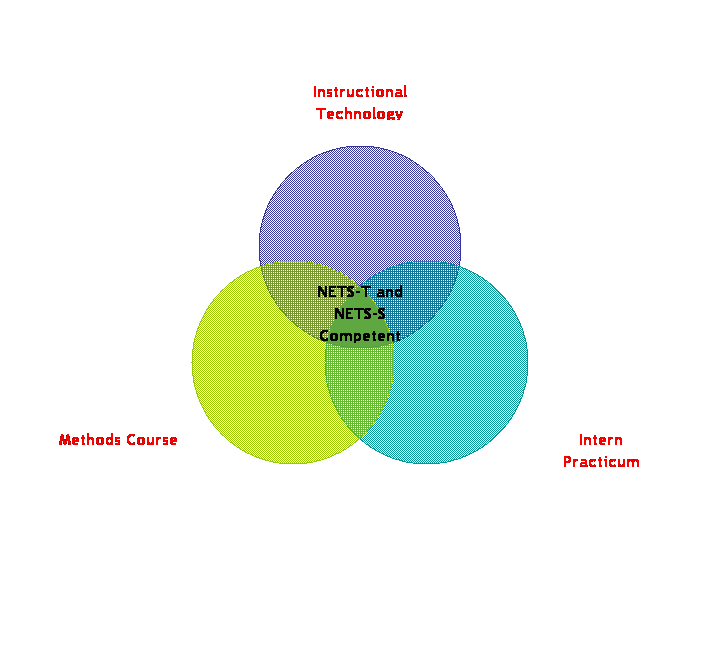
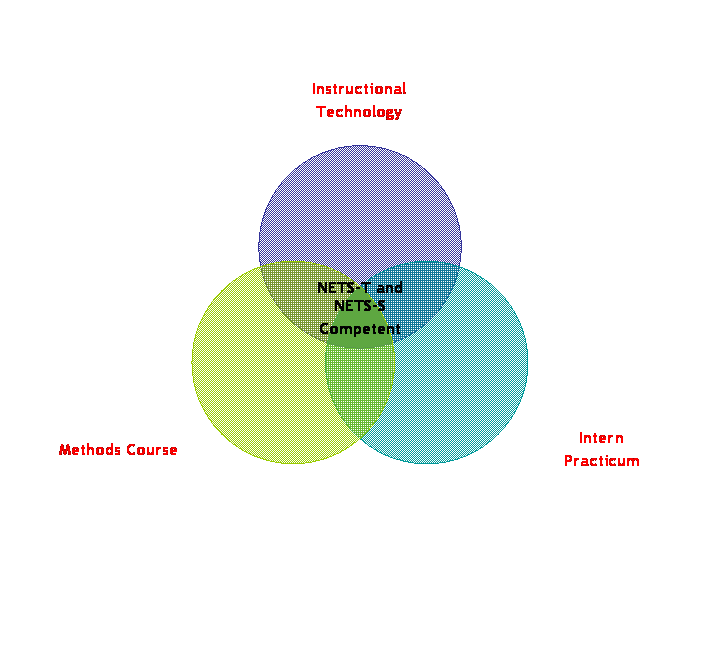
To prepare future teachers to integrate technology into instruction in accordance with the International Society for Technology Education's (ISTE) National Education Technology Standards for Teachers (NETS-T) and Students (NETS-S). Completion of this course reinforces the school wide mission of developing educators who are effective decision makers and reflective practitioners.
Course Goals &
Information
The purpose of this course is for students to become competent with ISTE Technology Standards. Students will also be exposed to educational technology on a broad scale. Students are expected to demonstrate an understanding of the importance of integrating technology into the classroom in an effort to develop lessons that impact the learners’ cognition and academic achievement, as well as a way to increase productivity and professionalism. This course intends to provide experiences for students so that they may successfully accomplish all of the NETS-S standards, and NETS-T standards (1A, 2B, 2C, 2D, 2E, 4A, 4B, 6D). Upon successful completion of this course, students will have evidences showing their competency of these standards. This course will provide a foundation of technology use to be built upon in future classes and the internship/practicum semesters. Students are expected to fulfill all other NETS-T standards (1B, 2A, 3A, 3B, 3C, 3D, 4C, 5A, 5C, 5D, 6A, 6B, 6C, 6E) beyond EDN 303. It is the student's responsibility to complete, record, save, and monitor their learning of these standards. The student will be expected to compile and/or demonstrate their competencies of all of these standards upon completion of student teaching internship.
Technology Framework
for the Watson School of Education
Watson School of
Education’s Conceptual Framework
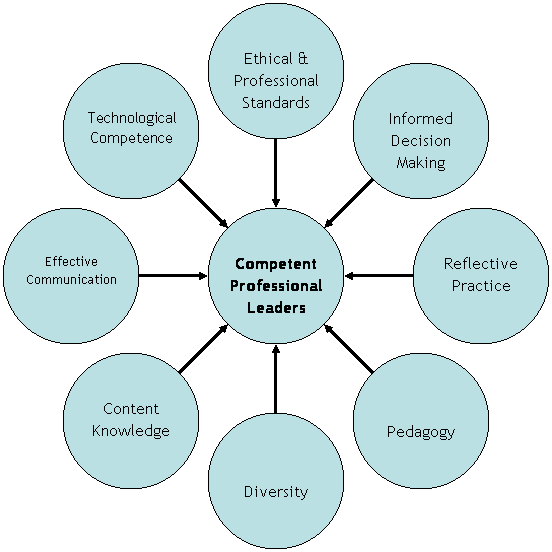
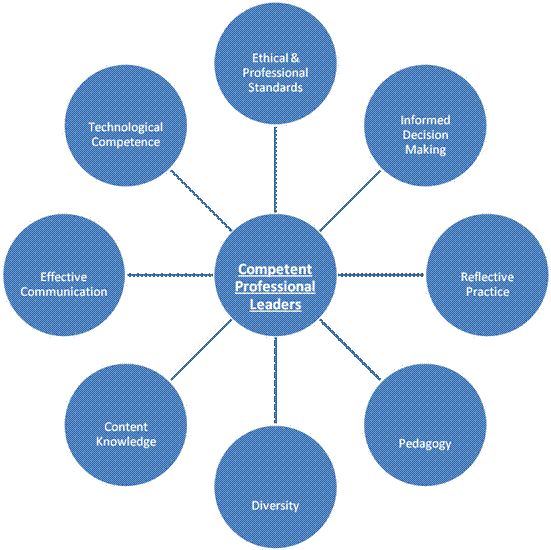
This course is designed to focus on key components of the Watson School of Education conceptual framework: The WSE develops highly competent professionals to serve in educational leadership roles. All educators must use data for decisions, reflect upon their practice, exemplify their commitment to professional standards, implement appropriate communication strategies, and strive to meet the needs of all learners. Assignments in this course will assist you in preparing you to be a competent professional and a leader.
Participation,
Attendance, and Academic Honor & Other Information
1. Attendance is required and expected. You will be allowed no more than two absences. Every additional absence will result in a ten-point penalty. Three late entrances/tardies and/or early departures equal one absence. Extreme emergencies and/or documented excused absences will be handled on a case-by-case basis.
CASE
STUDY: Tom has a difficult time getting up in the morning for his 9:30 class
because Tom works late on Sunday evenings, but that seems to be the only
section open for him. Tom enrolls in the
class anyway and, true to word, he misses 5 classes and exceeds his two
unexcused attendance limit by five class periods. Based on the syllabus directives, Tom has 30
points deducted from his final grade and fails EDN 303. It would have been best for Tom to find
another section or not take the class at all.
2. If you miss the day of a quiz, there will be NO make-up! All quizzes can be taken online and from home. Extreme emergencies and/or documented excused absences will be handled prior to the quiz date on a case-by-case basis.
CASE
STUDY: Michele will be out of town for a funeral and will miss Monday’s
class. There is a quiz on Monday
morning. She calls the instructor Monday
evening (after the quiz was given to the regular class) leaving a message as to
why she wasn’t able to attend class that day.
The instructor assigns her a zero for the quiz because he was not
informed prior to the quiz. Michele
should have informed the instructor prior to missing class and been given the
option to take it before she left town.
After the quiz is given, there will be NO make-up quiz.
3. Late assignments. Assignments submitted after the due date may result in a lower grade. Assignments submitted one class will be penalized 30%. Assignments will not be accepted after one class late unless there is an extreme emergency and/or a documented excused absence.
CASE
STUDY: Assignment #1 is collected the beginning of Monday’s class; Maria uses
the class period to complete her unfinished work and submits her assignment at
the end of that morning’s class. Maria’s work is considered late and 30 percent is deducted from her grade
for that assignment! Any student can submit late work through Wednesday morning
but it will be considered late and 30
percent will be deducted.
4. Students must complete all assignments as detailed in the course requirement section.
5. Adhere strictly to the UNCW Honor Code (See Student Handbook, Code of Student Life)
http://www.uncw.edu/stuaff/doso/documents/Code.Of.Student.Life.pdf
- Students are encouraged to complete take-home assignments elsewhere on campus or on their own computer, if appropriate. You will be expected to complete assignments using software identical to that found in the lab unless the instructor otherwise grants permission (highly unlikely). Assignments will be submitted on time, per teacher’s instructions.
CASE STUDY: Cindy has Word Perfect on her
computer at home. All assignments must
be completed using Microsoft Word for EDN 303.
Cindy will need to upgrade the software on her computer at home if she
wishes to use it for completing assignments for this class.
Contact the TAC for further assistance: http://www.uncw.edu/itsd/help/livesupport.html
- If you have prior experience and have developed a comfort level with computers, then you will probably do very well. However, if you are not proficient with computers, please plan on spending a large amount of time in the lab outside of class time, but, please, have no fear! I am here to assist you!
Use the tech
lab here in WSE Building: http://www.uncw.edu/ed/tech/
The Course Requirements at a Glance
|
Performance-Based
Assignment |
Corresponding Point Value |
|
Unit 1: Basic
Desktop Publishing |
20 |
|
Unit 2: Communication, Networks, and the Internet |
20 |
|
Unit 3: Hardware - Software |
20 |
|
Unit 4: Spreadsheets |
20 |
|
Unit 5: Integrating Multimedia |
40 |
|
Unit 6: Web Page
Development |
40 |
|
Unit 7: Security
issues, ethics, and emerging technology |
20 |
|
EDN 303 Portfolio, Final Presentation and Final Exam |
40 |
Traditional-Based
Assessments
|
|
|
Participation |
20 |
|
Three (3) Quizzes |
60 |
|
|
|
Total Points**
|
300 |
* The FINAL EXAM is scheduled for:
Friday, December 4th, 2009, 8:00 AM – 11:00 AM;
http://www.uncw.edu/reg/exams-fall09.htm
Access the Grading Rubric
** Failure to appear at the
final exam will result in a failing grade!
A copy of all work submitted during the semester
will be kept by the instructor. This work may be reviewed for departmental
accreditation purposes.
Students should understand there will NOT be a curve in EDN 303.
Grade Breakdown:
A = 280 – 300
A- = 270 – 279
B+ = 260 – 269
B = 250 – 259
B- = 240 – 249
C+ = 230 – 239
C = 220 – 229
C- = 210 – 219
D+ = 200 - 209
D = 180 - 209
F = 179 - 0
Participation & Professionalism –You earn
points by simply carrying yourself in a professional manner and by
satisfactorily participating in group work, discussions, and question and
answer sessions. This is to be
self-regulated, meaning that you control your actions and that the instructor
will not and should not need to advise you on your behavior.
Keep in mind, professional educators should be
role models for their students. Please familiarize yourself with the
requirements of the honor code found in the Student Handbook and Code of
Student Life.
Technology/computer classes can be stressful.
However, with a strong effort from you, collegial support from your peers, and
quality instruction from me we will work together to make this semester a
success. Please seek my advice and help whenever you need it. I have an open
door policy towards assisting my students, so feel free to ask me any question
any time, whether by e-mail, phone, or in person!
University Disability Policy
See Student Handbook,
Code of Student Life): http://www.uncw.edu/stuaff/doso/documents/Code.Of.Student.Life.pdf
Professional Behavior
Included in this area are behaviors and skills related to becoming a
professional educator, such as preparation for field-based assignments (e.g.,
having lesson plans completed); punctuality and attendance; appropriate attire;
development of positive rapport with children, parents, teachers, and
administrators; professional demeanor; professional interactions with
university students, faculty, staff, and administrators; use of standard English in oral and written
communications; and adherence to school rules and ethical standards. Partnership teachers, university supervisors,
and professors monitor these behaviors in class sessions, the Ed Lab, and
field-based assignments in school settings.
Things
to remember!
Do not bring food or drink to class.
Do remember to stay current with assigned due dates.
Do not be late to class.
Do demonstrate professional courtesy at all times
Do not use the computer for entertainment, games, email, etc. during class.
Do remember to save often.
Do not sit in your seat bored. Get up and help someone!
Do remember to enjoy yourself!
University
The
The primary mission of the Donald R. Watson
School of Education at the University of North Carolina at Wilmington is to
develop highly competent professionals to serve in teaching and other
educational leadership roles in southeastern North Carolina, the state, and
nation. The
UNCW practices a zero-tolerance policy for
violence and harassment of any kind. For emergencies contact UNCW CARE at
962-2273, Campus Police at 962-3184, or