|
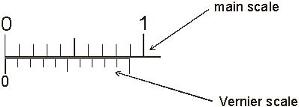
The VERNIER Scale A Vernier scale is a small, moveable scale placed next to the main scale of a measuring instrument. It is named after its inventor, Pierre Vernier (1580 - 1637). It allows us to make measurements to a precision of a small fraction of the smallest division on the main scale of the instrument. (In the first example below the "small fraction" is one tenth.) Vernier scales are found on many instruments, for example, spectroscopes, supports for astronomical telescopes etc. One specific example, the Vernier calliper, is considered below. Using a Vernier Scale Figure 1 shows a Vernier scale reading zero. Notice that 10 divisions of the Vernier scale have the same length as 9 divisions of the main scale.
In the following examples we will assume that the smallest division on the main scale is 1mm so the divisions on the Vernier scale are 0·9mm each. The position of the zero of the Vernier scale tells us the number of cm and mm in our measurement. For example, in figure 2, the reading is a little over 1·2cm.
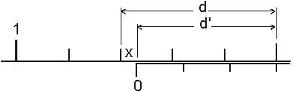
To find a more precise reading, consider figure 3 (which is a magnified view of part of figure 2).
We are, in effect, trying to find the distance, x. To find x, find the mark on the Vernier scale which most nearly coincides with a mark on the main scale. In figure 3 it is obviously the third mark. Now, it is clear that ............x = d - d’ Remembering that each division on the main scale is 1mm and that each division on the Vernier scale is 0·9mm, we have: x = 3mm - 3(0·9)mm = 3(0·1)mm Therefore, the reading in the example is: 1·23cm Similarly, if it had been, for example, the seventh mark on the Vernier scale which had been exactly opposite a mark on the main scale, the reading would be: 1·27cm Hence, the level of precision of an instrument which has a Vernier scale depends on the difference between the size of the smallest division on the main scale and the size of the smallest division on the Vernier scale. In the example above, this difference is 0·1mm so measurements made using this instrument should be stated as: reading ±0·1mm. Another instrument might have a scale like the one shown in figure 4.
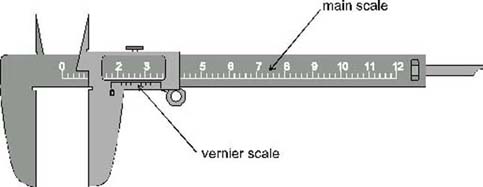
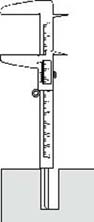
Therefore, the precision is: 1mm - (49/50)mm = (1/50)mm = 0·02mm. Results of measurements made using this instrument should therefore be stated as: reading ±0·02mm. This principle is used in the Vernier calliper shown below.
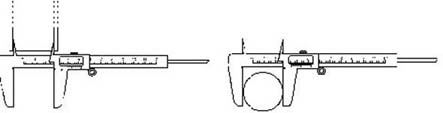
The diagrams below illustrate how to use a Vernier calliper to measure: A. the internal diameter of a
hollow cylinder
| ||||||||||||||||