The Next Little Thing?
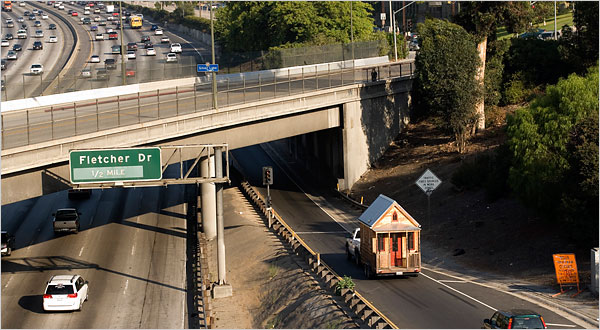
Stephanie Diani
for The New York Times
LITTLE
HOUSE ON THE FREEWAY Jay Shafer
took his 90-square-foot house on tour this summer, rolling along a
Published:
September 10, 2008 A version of this article appeared in print on September 11, 2008, on
page F1 of the
Multimedia
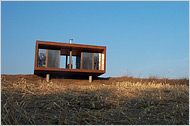
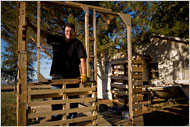
Heidi Schumann for The New York Times
THE LILLIPUTIAN
LIFE Some homeowners are using their
new little houses as offices or retreats, like the 80-square-foot one owned by
Michael Janzen.
So why has Mr. Janzen
spent the summer building an 80-square-foot “tiny house” out of free stuff he
found on Craigslist?
There
he is on nights and weekends, designing a floor plan whose dimensions are
measured not in feet but inches, nailing scavenged wood pallets together for
the frame, or fixing up an old trailer to serve as the foundation. The initial
reaction from his wife, Julia: “Is this a Unabomber building?”
Not exactly. According to Mr. Janzen, he
came to the realization that “I don’t want this life — the life of someone
who’s working too hard to pay a large mortgage to live in this house.” The
catalyst, he said, was watching the value of his home plummet with the rest of
the real estate market, while the time and money required to
maintain the property only increased. “The energy cost is enormous,” he
said, “and the bigger your property gets, the more there is to do.”
Which
is why Mr. Janzen has become interested in the small
house movement, whose adherents believe in minimizing one’s footprint —
structural as well as carbon — by living in spaces that are smaller than 1,000
square feet and, in some cases, smaller than 100. Tiny houses have been a
fringe curiosity for a decade or more, but devotees believe the concept’s time
has finally arrived.
“It’s
a very exciting moment,” said Shay Salomon, a green builder in
Gregory
Paul Johnson, a founder of the Small House Society in
In
July, Mr. Johnson, who lives in a 140-square-foot house made by the Tumbleweed
Tiny House Company of
Along
the way they stopped to hold workshops and give (very brief) home tours. Some
events drew hundreds of people. “It seems like everybody is fascinated by the
idea of living in a tiny house,” said Mr. Shafer, who started Tumbleweed eight
years ago. “But for a long time, I was just selling the dream.”
His
business is still modest, but in the past year Mr. Shafer has sold five houses
and 50 sets of plans, up from a yearly average of one house. The houses range
in size from about 70 to nearly 800 square feet, cost $20,000 to $90,000 to build,
and resemble birdhouses: boxy shape, wood siding and high, pitched roof.
Other
builders also report increased demand. Brad Kittel,
owner of Tiny Texas Houses in
In
recent years, small dwellings have begun to get the high-design treatment,
which could attract more people. The London-based designer Nina Tolstrup built the 388-square-foot Tiny Beach Chalet, which
has drawn attention on design blogs. One of the stars
of the
“When
you build small you can spend money on higher-quality materials,” said Jared
Volpe, a Web designer in North
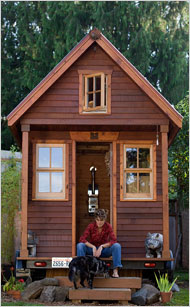
Karie Hamilton for The New York Times
Others choose to actually live
in theirs, like Dee Williams, whose 84-square-foot knotty-pine house has a
tight but cozy interior.
For
Mr. Janzen, a tiny house is not an immediate solution
to his frustrations with large-scale living; he has no intention of cramming
his wife and young daughter into 80 square feet. Instead, he plans to use the
structure as an office, or park it on his in-laws’ farm as a weekend retreat, a
more traditional use for tiny houses. But he will treat it as an “intellectual
exercise,” he said, that will allow him to develop “an idea of the other
extreme of size.”
“I’ll
have a sense of where the balance is,” he added — a sense that he hopes will
help his family decide on a reasonable goal for downsizing, something he is
eager to do soon. “We bought this house, I think, for prestige,” he said,
sounding chastened.
But
while Mr. Janzen is dabbling with tiny living, others
are plunging in. Tara Flannery, a 25-year-old college student in
“I
wanted to buy my own place by 30, and the way the housing market is going
that’s not going to happen,” she said, referring to the tightening credit
market and the fact that home prices remain high in Seattle, despite the
mortgage crisis.
In
a way, Ms. Flannery’s tiny house, which will be about 100 square feet with a
sleeping loft and will cost roughly $40,000, is a modern twist on the starter
homes of the 1950s suburbs; it offers her a way into home ownership, of a sort,
without the debilitating costs. “I can spend my money traveling instead,” she
said.
It’s
an unencumbered lifestyle that Dee Williams, a hazardous waste inspector an
hour away in
Ms.
Williams, 45, said that before the move, “I was an environmentalist, but not a
very dedicated one.” She built her house, which she outfitted with solar panels
and propane heating, both to “walk the talk” of eco-consciousness and “to
unshackle myself from a mortgage and doing repairs.” Although last year, like
most Americans, she saw a sharp rise in her monthly energy bill, the increase —
from $4 to $8 — didn’t exactly bankrupt her, she said.
Mr.
Janzen, meanwhile, worries that an activist like Mr.
Shafer, the Tumbleweed founder, “would look at someone like me and say I’m only
taking a half-step.”
Asked
if that were the case, Mr. Shafer said he doesn’t advocate for everyone to live
as he does. “I know 100 square feet is too small for most people,” he said,
including his new bride, who lives next door to Mr. Shafer in a 700-square-foot
house (although he is planning to build her a 300-square-foot replacement).
Instead, he wants to be a living example encouraging people to downsize, even
if it’s only to a moderately smaller home.
The
Janzens plan to do just that, as soon as the housing
market bounces back and they can sell their current home without taking a loss.
The couple wants to move back to