About Death, Just Like Us or Pretty Much Unaware?
Published:
September 1, 2008 A version of this article appeared in print on September 2, 2008, on
page F1 of the
As
anybody who has grieved inconsolably over the death of a loved one can attest,
extended mourning is, in part, a perverse kind of optimism. Surely this bottomless,
unwavering sorrow will amount to something, goes the tape loop. Surely if I
keep it up long enough I’ll accomplish my goal, and the person will stop being
dead.
Oliver Werner/Getty
Images
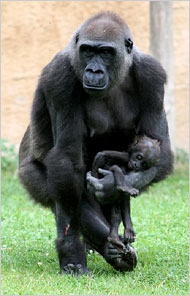
MOURNING OR
CONFUSED? Gana
held her dead baby, Claudio, for days.
Last week the Internet and
European news outlets were flooded with poignant photographs of Gana, an 11-year-old gorilla at the Münster
Zoo in
Nobody
knows what emotions swept through Gana’s head and
heart as she persisted in cradling and nuzzling the remains of her son. But primatologists do know this: Among nearly all species of
apes and monkeys in the wild, a mother will react to the death of her infant as
Gana did — by clutching the little decedent to her
breast and treating it as though it were still alive. For days or even weeks
afterward, she will take it with her everywhere and fight off anything that
threatens to snatch it away. “The only time I was ever mobbed by langurs was when I tried to inspect a baby corpse,” said
the primatologist Sarah Hrdy.
Only gradually will she allow the distance between herself and the ever-gnarlier carcass to grow.
Yes,
we’re a lot like other primates, particularly the great apes, with whom we have
more than 98 percent of our genes in common. Yet elaborate displays of apparent
maternal grief like Gana’s may reveal less about our
shared awareness of death than our shared impulse to act as though it didn’t
exist. Dr. Hrdy, author of “Mother Nature” and the
coming “Mothers and Others,” said it made adaptive sense for a primate mother
to hang onto her motionless baby and keep her hopes high for a while. “If the
baby wasn’t dead, but temporarily comatose, because it was sick or fallen from
the tree, well, it might come back to life,” Dr. Hrdy
said. “We’re talking about primates who have singleton births after long
periods of gestation. Each baby represents an enormous investment for the
mother.”
Everywhere
in nature, biologists say, are examples of animals behaving as though they were
at least vaguely aware of death’s brutal supremacy and yet unpersuaded
that it had anything to do with them. Michael Wilson, an assistant professor of
anthropology at the University of Minnesota
who has studied chimpanzees at Jane Goodall’s research site in Gombe, said
chimps were “very different from us in terms of what they understand about
death and the difference between the living and the dead.” The Hallmark hanky
moment alternates with the Roald Dahl macabre. A
mother will try to nurse her dead baby back to life, Dr. Wilson said, “but when
the infant becomes quite decayed, she’ll carry it by just one leg or sling it
over her back in a casual way.”
Juvenile
chimpanzees display signs of genuine grief when their mothers die. In one
famous case in Gombe, when a matriarch of the troop
named Flo died at the age of 50-plus years, her son,
Yet
adult chimpanzees rarely react with overt sentimentality to the death of
another adult, Dr. Wilson said. As a rule, sick or elderly adults go off into
the forest to die alone, he said, and those that die in company often do so at
the hands of other adults, who “sometimes make sure the victim is dead, and
sometimes they don’t,” he said. The same laissez-faire attitude toward
death-versus-life applies to chimpanzee hunting behavior. “When they’re hunting
red colobus monkeys, they will either kill the
monkeys first or simply immobilize them and start eating them while they’re
still alive,” Dr. Wilson said. “The monkey will continue screaming and
thrashing as they pull its guts out, which is very unpleasant for humans who
are watching.”
For
some animals, the death of a conspecific is a little
tinkle of the dinner bell. A lion will approach another lion’s corpse, give it
a sniff and a lick, and if the corpse is fresh enough, will start to eat it.
For others, a corpse is considered dangerous and must be properly disposed of.
Among naked mole
rats, for example, which are elaborately social mammals that spend their entire
lives in a system of underground tunnels, a corpse is
detected quickly and then dragged, kicked or carried to the communal latrine.
And when the latrine is filled, said Paul Sherman of Cornell University,
“they seal it off with an earthen plug, presumably for hygienic reasons, and
dig a new one.”
Among
the social insects, the need for prompt corpse management is considered so
pressing that there are dedicated undertakers, workers that within a few
minutes of a death will pick up the body and hoist or fly it outside, to a safe
distance from hive or nest, the better to protect against possible contagious
disease. Honeybees are such compulsive housekeepers that if a mouse or other
large creature, drawn by the warmth or promise of honey, happens to make its
way into the hive and die inside, the bees, unable to bodily remove it, will embalm it in resin
collected from trees. “You can find mummified mice inside beehives that are
completely preserved right down to their whiskers,” said Gene E. Robinson,
professor of entomology at the University of Illinois
in Urbana-Champaign.
But
all is not grim for those dead in tooth and claw. Researchers have determined
that elephants deserve their longstanding reputation as exceptionally
death-savvy beings, their concern for the remains of their fellows approaching
what we might call reverence. Reporting in the journal Biology Letters, Karen McComb of the University of Sussex and her colleagues found
that when African elephants were presented with an array of bones and other
natural objects, the elephants spent considerably more time exploring the
skulls and tusks of elephants than they did anything else, including the skulls
of rhinoceroses and other large mammals.
George
Wittemyer of Colorado State University
and his colleagues described in Applied Animal Behavior Science the
extraordinary reactions of different elephants to the death of one of their
prominent matriarchs. “One female stood over the body, rocking back and forth,”
Dr. Wittemyer said in an interview. “Others raised
their foot over her head. Others touched their tusks to hers. They would do
their behaviors, and then leave.”
They
were saying goodbye, or maybe, Won’t you please come
back home?